

Finding the best fertility hospital Southwest Nigeria is one of the most emotionally charged and consequential decisions you will ever make. Whether you are dealing with unexplained delays, blocked tubes, low sperm metrics, or simply seeking clarity after months—or years—of trying, the right medical team changes everything.
Southwest Nigeria—spanning Lagos, Ondo, Oyo, Ogun, Osun, and Ekiti—has quietly evolved into sub-Saharan Africa’s premier engine for reproductive medicine. But with dozens of clinics popping up across the region, cutting through marketing promises to find genuine clinical capability can feel overwhelming.
This guide breaks down what actually constitutes top-tier reproductive care in our region, how to evaluate medical infrastructure without getting bogged down in jargon, what treatment paths look like in practice, and why Netcare IVF & Fertility Centre in Akure, Ondo State, has become a trusted landmark for couples across the country.
Ready to Take the First Step Toward Your Miracle?
Don’t navigate your fertility journey alone. Talk to our compassionate medical team today to schedule your consultation or ask any questions in confidence.
Direct Verdict: What Defines the Best Fertility Hospital in Southwest Nigeria?
The best fertility center isn’t simply the one with the biggest signboards or the busiest waiting room. It is a facility that consistently aligns three variables: advanced embryology lab technology, transparent evidence-based protocols, and human-centered care.
While cities like Lagos offer a dense concentration of clinics, medical quality isn’t limited to commercial capitals. Netcare IVF & Fertility Centre, situated in the calm, accessible environment of Akure, Ondo State, serves as a high-performing regional hub. Netcare pairs high-tier embryology—such as Intracytoplasmic Sperm Injection (ICSI), Blastocyst Culture, and Ovarian Rejuvenation—with accessible, patient-first care that spares couples the immense financial and mental strain typical of mega-city transit.
┌─────────────────────────────────────────────────────────────────────────────────┐
│                    THE THREE PILLARS OF CLINICAL EXCELLENCE                     │
├───────────────────────────┬───────────────────────────┬─────────────────────────┤
│ Embryology Lab Quality    │ Individualized Medicine   │ Psychological Support   │
│ • Tri-gas incubators      │ • Custom drug dosing      │ • Stress mitigation     │
│ • Cleanroom filtration    │ • Age-matched protocols   │ • Honest counseling     │
│ • ICSI / Cryo accuracy    │ • Targeted diagnostics    │ • Transparent expectations│
└───────────────────────────┴───────────────────────────┴─────────────────────────┘
7 Critical Criteria for Choosing an IVF Hospital in Southwest Nigeria
If you are currently researching options across Lagos, Ibadan, Akure, or Abeokuta, look past basic glossy brochures. Ask probing questions based on these seven essential benchmarks:
1. Embryology Laboratory Standards
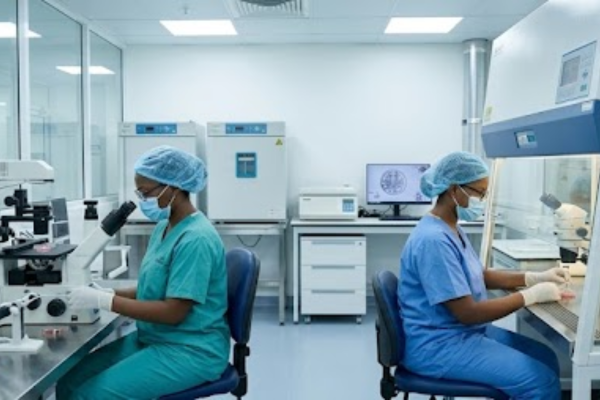
The embryology lab is where magic meets exact science. An egg and sperm cannot thrive in a sub-optimal environment. The best centers invest heavily in HEPA air filtration systems (to remove airborne volatile organic compounds that kill delicate embryos), precise tri-gas incubators that simulate the exact oxygen and carbon dioxide levels of a human fallopian tube, and continuous power redundancy systems.
2. Clinical Success Metrics (By Age Bracket)
Be wary of any clinic claiming a flat “80% or 90% success rate” across the board. Real fertility medicine is nuanced, and success rates naturally correlate with maternal age and underlying diagnoses. A trustworthy clinic provides transparent, age-adjusted data:
- Under 35 years: Highest success rates, frequently exceeding 60% per transfer.
- Ages 35–37: Robust success, typically ranging between 45% and 55%.
- Ages 38–40: Moderately reduced natural yield, often requiring optimized stimulation or genetic screening.
- Over 40: Lower natural egg yield, where customized donor protocols or advanced embryo pooling often yield the best outcomes.
3. Depth of Advanced Assisted Reproductive Tech (ART)
Standard IVF—simply putting eggs and sperm together in a dish—is only one piece of the puzzle. Top facilities must be fully equipped for advanced interventions:
- ICSI (Intracytoplasmic Sperm Injection): Crucial for male factor infertility, where a single selected sperm is injected directly into an egg.
- Laser-Assisted Hatching: Gently thinning the embryo’s outer shell (zona pellucida) to encourage successful implantation in the uterine wall.
- Blastocyst Culture: Growing embryos to Day 5 or Day 6 rather than transferring on Day 3, drastically improving selection accuracy.
- Ovarian Rejuvenation (PRP): Using concentrated growth factors from a patient’s own blood to stimulate dormant ovarian tissue.
4. Specialization of the Medical Team
Reproductive medicine requires a tightly coordinated team. You need board-certified Reproductive Endocrinologists, Consultant Obstetricians & Gynecologists with specialized ART fellowship training, full-time Senior Embryologists (not just visiting consultants who drop in occasionally), and dedicated fertility nurses who understand the emotional weight of every phone call.
5. Transparent Financial Structures
Fertility treatment can quickly become stressful if costs are unpredictable. The ideal center outlines clear, predictable package options that clearly delineate what is included—such as lab fees, ultrasounds, egg retrieval, and embryo transfer—so families can plan financially without unpleasant surprises midway through a cycle.
6. Environmental Stress Reduction & Geographic Accessibility
It is a well-documented biological fact that elevated cortisol (stress hormones) can negatively impact how your body responds to fertility medications and hormones. Trying to navigate grueling daily traffic jams during a 12-day stimulation cycle adds unnecessary friction. Facilities located in tranquil, centralized settings offer a distinct psychological advantage during treatment.
7. Ethical and Confidential Frameworks
From egg and sperm donor screening to surrogacy oversight and genetic privacy, reproductive medicine demands strict adherence to ethical standards, legal boundaries, and total patient confidentiality.
Understanding Your Options: Comprehensive Diagnostics & Treatments
No two fertility journeys look identical. What works for your friend or relative might be entirely wrong for your specific physiological picture. A thorough hospital evaluation always begins with targeted diagnostics before deciding on an intervention.
                         ┌─────────────────────────────────┐
                         │   Initial Diagnostic Workup     │
                         │ (Ultrasound, Hormones, Semen)   │
                         └────────────────┬────────────────┘
                                          │
            ┌─────────────────────────────┴─────────────────────────────┐
            ▼                                                           ▼
┌───────────────────────┐                                   ┌───────────────────────┐
│   Female Pathways     │                                   │    Male Pathways      │
├───────────────────────┤                                   ├───────────────────────┤
│ • Ovulation Induction │                                   │ • Advanced Semen Analysis│
│ • IUI (Insemination)  │                                   │ • Sperm Freezing      │
│ • Standard IVF        │                                   │ • ICSI Interventions  │
│ • Egg Freezing        │                                   │ • Surgical Retrieval  │
│ • Hysteroscopy/PRP    │                                   │   (TESA / TESE)       │
└───────────────────────┘                                   └───────────────────────┘
Advanced Female Reproductive Care
- Ovulation Induction: Medication protocols designed to stimulate mature egg release for women with irregular cycles, PCOS, or anovulation.
- Intrauterine Insemination (IUI): A less invasive procedure where washed, highly motile sperm are placed directly into the uterus around the exact time of ovulation.
- In-Vitro Fertilization (IVF): The gold standard of ART, where eggs are harvested under ultrasound guidance, fertilized in a specialized lab, and nurtured into healthy embryos before being placed in the womb.
- Egg Freezing (Oocyte Cryopreservation): Preserving healthy, young eggs for medical reasons or life planning, halting the biological clock until you are ready.
- Minimally Invasive Procedures (Hysteroscopy & Laparoscopy): Diagnostic and operative surgical techniques to clear tubal blockages, remove fibroids or polyps, and fix intrauterine adhesions without large incisions.
Specialized Male Reproductive Solutions
Male factor conditions account for roughly half of all fertility challenges, yet they are frequently overlooked. Modern reproductive care addresses these directly:
- Advanced Semen Analysis: Moving beyond basic counts to analyze sperm morphology (shape), motility (movement), and overall vitality.
- ICSI (Intracytoplasmic Sperm Injection): A game-changing technique where a single high-quality sperm is isolated and injected directly into the cytoplasm of a mature egg, overcoming extremely low counts or poor movement.
- Surgical Sperm Retrieval (TESA/TESE): When no sperm is present in the ejaculate (azoospermia), specialized urological procedures can often harvest viable sperm directly from testicular tissue.
Donor Programs & Specialized Care
- Donor Egg & Sperm Services: Thoroughly screened, healthy donors matching physical profiles and background characteristics, conducted under strict medical and ethical protocols.
- Gestational Surrogacy Support: For women unable to carry a pregnancy due to uterine conditions or severe medical risk, working alongside carefully vetted surrogates.
Why Netcare IVF & Fertility Centre is the best fertility hospital Southwest Nigeria
Nestled in the serene residential layout of 10 Owo Avenue, Ijapo Estate, Akure, Ondo State, Netcare IVF & Fertility Centre was built around a singular idea: world-class fertility care should be compassionate, technologically flawless, and accessible.
┌─────────────────────────────────────────────────────────────────────────────────┐
│                  WHAT MAKES NETCARE FERTILITY CENTRE DIFFERENT                  │
├───────────────────────────┬───────────────────────────┬─────────────────────────┤
│ Strategic Central Location│ High-Tier Lab Tech        │ Genuine Patient Care    │
│ Easily accessible from    │ State-of-the-art ICSI,    │ No rush, individualized │
│ Ondo, Ekiti, Oyo, Osun,   │ Cryopreservation, and     │ attention for every single│
│ Ogun, Edo, and Lagos.     │ Advanced Embryo Culture.  │ family history.         │
└───────────────────────────┴───────────────────────────┴─────────────────────────┘
1. High Clinical Success Standards
Netcare maintains an embryology laboratory equipped with cutting-edge incubation, cryopreservation, and micro-manipulation technology. By adhering strictly to international evidence-based standards, Netcare delivers clinical pregnancy rates that rival top international centers.
2. A Restful Environment for Treatment
Undergoing hormonal stimulation requires physical and emotional calm. Located in the peaceful environment of Ijapo Estate, Akure, Netcare offers an ideal sanctuary. Patients traveling from across Southwest Nigeria avoid the high-stress environment of mega-cities, allowing them to undergo treatment in comfort.
3. Clear, Predictable Planning
At Netcare, financial transparency is a core value. Patients receive straightforward explanations of their treatment costs up front—eliminating hidden add-ons so families can focus entirely on their treatment rather than unexpected financial demands.
4. Comprehensive In-House Diagnostics
From hormone panels and 3D pelvic imaging to diagnostic hysteroscopies and semen preparation, Netcare provides complete end-to-end services under one roof. This minimizes travel and speeds up treatment timelines.
5. Tailored, Empathetic Care
You are never treated like a case file or a procedure code. Netcare’s specialists sit down with you, listen to your journey, review past cycle failures if you have them, and design a customized protocol built around your body.
Step-by-Step: The IVF Treatment Process at Netcare
Knowing what lies ahead brings clarity and confidence. Here is a clear breakdown of how an IVF cycle typically unfolds at Netcare Fertility Centre:
1.1. Comprehensive Initial Evaluation: Duration: 1–2 Weeks.
Both partners undergo essential baseline evaluations, including high-resolution pelvic ultrasounds, hormonal panels (AMH, FSH, LH, Prolactin), and semen analysis to pinpoint underlying factors.
2.2. Ovarian Stimulation & Monitoring: Duration: 10–12 Days.
Customized medication protocols stimulate the ovaries to mature multiple eggs. Progress is carefully monitored through targeted ultrasound scans and hormone checks to adjust dosing safely.
3.3. Egg Harvest & Sperm Preparation: Day 12–14.
A short, painless procedure performed under light sedation extracts the mature eggs. On the same morning, the male partner provides a semen sample, which is processed to select the most motile sperm.
4.4. Fertilization & Embryo Development: Days 1–5.
Using standard IVF or precise ICSI, eggs are fertilized in the cleanroom laboratory. The resulting embryos are monitored as they grow into strong blastocysts over 3 to 5 days.
5.5. Embryo Transfer & Cryopreservation:Day 5 or Deferred Cycle.
The highest-grade embryo is gently placed into the uterus using a fine catheter. Any additional healthy, high-grade blastocysts are frozen via vitrification for future cycles.
6.6. Post-Transfer Care & Confirmation:14 Days Post-Transfer.
Targeted hormone support is maintained during the two-week waiting period. A blood test measures Beta-hCG levels to confirm pregnancy, followed by early obstetric care.
Answers to Frequently Asked Questions
What factors influence the cost of IVF in Southwest Nigeria?
IVF treatment costs depend heavily on the specific medical interventions required. Factors include the dosage of hormonal stimulation medications needed, whether specialized techniques like ICSI or laser-assisted hatching are necessary, and if genetic testing or donor services are utilized. Netcare provides detailed cost estimates during your initial consultation so you can plan clearly.
When should a couple seek a fertility consultation?
Medical guidelines recommend seeking a fertility evaluation if you have been having regular, unprotected intercourse without conceiving for 12 months (if the female partner is under 35) or for 6 months (if the female partner is 35 or older). Immediate evaluation is recommended if you have known conditions such as irregular cycles, blocked tubes, or severe male factor challenges.
Can I undergo treatment if I live outside Ondo State?
Absolutely. Many patients travel to Netcare from Lagos, Ibadan, Abeokuta, Benin, Abuja, and surrounding areas. Netcare offers streamlined consultation schedules and local support to accommodate out-of-town patients smoothly throughout their cycle.
What is the difference between standard IVF and ICSI?
In conventional IVF, thousands of sperm are placed near an egg in a laboratory dish, allowing natural fertilization to take place. In ICSI (Intracytoplasmic Sperm Injection), an embryologist selects a single healthy sperm and injects it directly into the egg. ICSI is particularly effective for severe male factor infertility or previous fertilization challenges.
How does location impact IVF cycle outcomes?
Physical stress, travel anxiety, and environmental exhaustion directly affect your body’s stress hormones. Being in a peaceful, easily accessible facility allows patients to rest properly between clinic appointments, supporting physical recovery and hormonal balance.
Take Your Next Step Toward Parenthood
Navigating fertility challenges can feel heavy, but you do not have to walk this path without expert guidance. Modern reproductive medicine offers more hope and higher success rates today than at any point in history. Whether you are seeking your very first diagnostic opinion or looking for advanced solutions after a previous setback, the dedicated team at Netcare IVF & Fertility Centre is ready to walk with you every step of the way.
Ready to Take the First Step Toward Your Miracle?
Don’t navigate your fertility journey alone. Talk to our compassionate medical team today to schedule your consultation or ask any questions in confidence.