
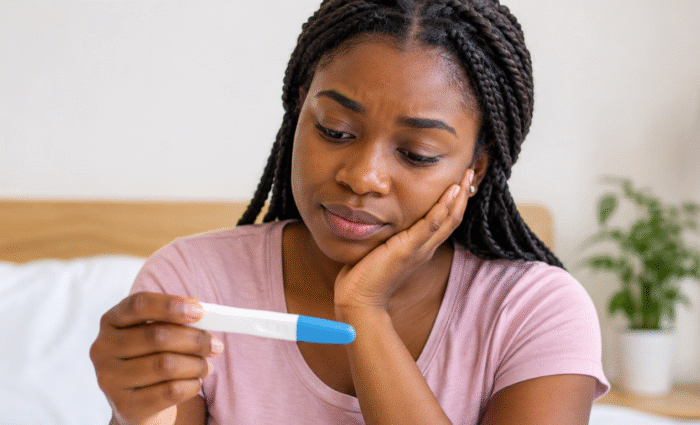

Can you have infertility without symptoms?
Yes. Infertility can occur without obvious symptoms. In some people, difficulty becoming pregnant is the first noticeable indication that there may be a fertility problem. Conditions affecting the fallopian tubes, sperm quality, reproductive anatomy or other aspects of fertility don’t always produce clear warning signs.
That’s one reason fertility testing can be valuable when pregnancy isn’t happening as expected. Feeling healthy is reassuring, but it doesn’t tell you everything about reproductive function.
What Is Infertility?
Infertility is generally defined as being unable to achieve pregnancy after 12 months or more of regular, unprotected sexual intercourse.
It can affect either partner.
Female infertility may involve problems with the ovaries, fallopian tubes, uterus or reproductive hormones. Male infertility may involve sperm production, sperm movement, sperm shape, ejaculation or reproductive-tract obstruction.
There are also situations where standard fertility testing doesn’t identify a clear cause. This is commonly referred to as unexplained infertility.
So infertility isn’t always a condition you can recognise by the way you feel.
Can Infertility Really Have No Symptoms?
Yes, and this can surprise people.
Some fertility conditions produce noticeable signs such as irregular periods, absent periods, pelvic pain or sexual difficulties. Others can remain relatively quiet.
Someone can have apparently regular menstrual cycles while another fertility factor is affecting conception. A man can feel completely healthy and have no obvious sexual problems while a semen analysis identifies an issue with sperm count, movement or shape.
This is why there’s an important distinction between feeling healthy and knowing your fertility status.
You usually can’t determine sperm quality by appearance or general health. You also can’t tell whether the fallopian tubes are open simply because menstrual periods are regular.
Sometimes testing is what reveals the missing piece.
What Causes Infertility Without Obvious Symptoms?
There isn’t one single cause of “silent infertility.” Several reproductive problems can exist with few or no noticeable warning signs.
1. Blocked or Damaged Fallopian Tubes
The fallopian tubes play an essential role in natural conception. After ovulation, an egg enters a fallopian tube, where fertilisation would usually occur before the resulting embryo travels towards the uterus.
If one or both tubes are blocked or damaged, conception can become more difficult.
The tricky part? Tubal problems don’t necessarily cause symptoms.
Previous pelvic infections, some sexually transmitted infections, pelvic or abdominal surgery and other reproductive conditions may contribute to tubal damage.
A person may therefore continue having periods normally without knowing there is a tubal problem.
Tests such as a hysterosalpingogram (HSG) can be used during fertility evaluation to investigate whether the fallopian tubes are open.
2. Male-Factor Infertility
Male fertility problems are another reason a couple can experience difficulty conceiving without an obvious explanation.
A man may have a normal sex drive, normal erections and ejaculation and still have abnormalities involving:
- Sperm concentration
- Sperm movement (motility)
- Sperm shape (morphology)
- Semen production or delivery
These problems aren’t something you can reliably identify just by looking at semen or assessing how healthy someone feels.
A semen analysis is therefore an important part of a fertility assessment when a male partner is contributing sperm.
Fertility shouldn’t automatically be treated as a “woman’s problem.” When appropriate, both partners should be assessed.
3. Subtle Ovulation Problems
Ovulation disorders often produce noticeable menstrual changes. Periods may become irregular, very widely spaced or disappear altogether.
But reproductive function isn’t always that straightforward.
Some ovulatory problems can be more subtle, and menstrual history is only one part of a complete fertility assessment.
A fertility specialist may consider your cycle history alongside other relevant investigations depending on your circumstances.
4. Endometriosis
Endometriosis is associated with fertility problems and can cause symptoms such as painful periods, pelvic pain or pain during sex.
However, symptom severity varies considerably.
Some people experience significant symptoms, while others may have relatively mild signs. This means the absence of severe pelvic pain shouldn’t be used by itself to rule out reproductive conditions.
5. Changes in Ovarian Reserve
Ovarian reserve refers broadly to the number of eggs remaining in the ovaries.
It naturally declines with age, although the rate isn’t identical for everyone.
Changes in ovarian reserve don’t necessarily announce themselves with obvious day-to-day symptoms. Someone may feel healthy and continue menstruating regularly.
Tests such as anti-Müllerian hormone (AMH) and an antral follicle count may be used as part of an appropriate fertility assessment. However, ovarian reserve testing isn’t a simple “fertile or infertile” test. Results need to be interpreted within the wider clinical picture.
6. Uterine or Reproductive-Tract Problems
Structural conditions involving the uterus or reproductive tract can sometimes interfere with fertility.
Depending on the condition, symptoms may be obvious, mild or absent.
This is one reason fertility assessment can include imaging rather than relying only on symptoms. A pelvic ultrasound, for example, can help a fertility specialist evaluate reproductive anatomy.
7. Unexplained Infertility
Sometimes the tests come back looking reassuring, yet pregnancy still doesn’t happen.
This is known as unexplained infertility.
It doesn’t mean the fertility difficulty is imaginary, nor does it necessarily mean that nothing is affecting conception. Rather, routine fertility investigations haven’t identified a specific explanation.
That’s an important distinction.
Medicine can evaluate many parts of reproduction, but conception is a complex process involving ovulation, sperm, fertilisation, embryo development, transport and implantation. Not every problem within that process can always be identified through standard testing.
Are There Early Signs of Infertility?
There is no universal set of early infertility symptoms.
For some couples, the main sign is simply not becoming pregnant after trying for the expected period of time.
When symptoms are present, they depend on the underlying cause.
Possible signs that deserve medical discussion can include:
- Irregular menstrual cycles
- Missing periods
- Very short or unusually long cycles
- Pelvic pain
- Pain during sexual intercourse
- Problems with ejaculation
- Erectile or sexual difficulties
- Other reproductive or hormonal changes
Having one of these symptoms doesn’t automatically mean you’re infertile. Likewise, having none of them doesn’t guarantee that fertility is normal.
Does Having Regular Periods Mean You’re Fertile?
Not necessarily.
Regular menstrual cycles can be a useful indicator of regular ovulation. In women with regular cycles of approximately 21–35 days, menstrual history can provide useful information about ovulatory patterns.
But fertility requires more than ovulation.
For pregnancy to occur naturally, several things have to work together: an egg needs to be released, sperm must be available and capable of fertilisation, the reproductive tract must allow the sperm and egg to meet, and an embryo must ultimately reach and implant in the uterus.
Regular periods tell you something useful. They don’t answer every fertility question.
Can Men Have Infertility Without Symptoms?
Absolutely.
Male infertility can be particularly difficult to recognise without testing because abnormalities in sperm production don’t always affect sexual performance or general health.
Someone may have:
- Normal libido
- Normal erections
- Normal ejaculation
- No genital pain
- No obvious medical problem
and still have a sperm-related fertility issue.
A semen analysis measures important characteristics of the semen and sperm and is commonly included in fertility evaluation.
This is also why fertility assessment should generally involve both partners when appropriate instead of putting the entire diagnostic burden on the woman.
How Is Infertility Without Symptoms Diagnosed?
If there are no obvious symptoms, the process usually starts with your fertility history rather than trying to guess what’s wrong.
A fertility specialist may ask about:
- How long you’ve been trying to conceive
- Menstrual-cycle patterns
- Previous pregnancies
- Previous miscarriages
- Medical conditions
- Previous pelvic infections
- Surgeries
- Medications
- Sexual and reproductive history
- Relevant lifestyle factors
From there, appropriate fertility investigations can be selected.
Common Fertility Tests for Women
Depending on medical history and individual circumstances, evaluation may involve:
Pelvic ultrasound:
Used to examine the uterus, ovaries and other pelvic structures.
Hormonal assessment:
Selected hormone tests may help investigate ovulatory or endocrine problems when clinically appropriate.
Ovarian reserve assessment:
Tests such as AMH or antral follicle count can provide information that may help guide fertility treatment decisions.
Hysterosalpingogram (HSG):
This investigation can help determine whether the fallopian tubes are open and provide information about the uterine cavity.
Additional investigations may be recommended depending on what the initial assessment finds.
Common Fertility Tests for Men
One of the most important initial investigations is semen analysis.
It assesses factors such as sperm concentration, motility and morphology.
Additional testing isn’t automatically necessary for every man. A fertility specialist can determine whether further evaluation is appropriate based on medical history and initial results.
When Should You Get a Fertility Evaluation?
For women younger than 35, fertility evaluation is generally recommended after 12 months of regular unprotected intercourse without pregnancy.
For women aged 35 and older, evaluation is generally recommended after 6 months of trying without pregnancy.
For women over 40, earlier evaluation may be appropriate.
But you don’t always need to wait six or twelve months.
Earlier assessment may be recommended when there is a known or suspected condition that could affect fertility, such as irregular or absent menstrual cycles, suspected endometriosis, known uterine or tubal disease, suspected male-factor infertility or certain previous medical treatments.
Your individual medical history matters more than a generic timeline.
Common Myths About Infertility Without Symptoms
Myth 1: “I Have Regular Periods, So I Can’t Have Fertility Problems”
Regular periods are reassuring when assessing ovulation, but they don’t confirm that every part of the reproductive process is functioning normally.
Myth 2: “We’re Both Healthy, So Fertility Shouldn’t Be a Problem”
General health and reproductive health overlap, but they’re not identical.
People who exercise, eat well and have no known chronic illness can still experience fertility difficulties.
Myth 3: “If There Were a Problem With His Sperm, He Would Know”
Usually, you can’t judge sperm concentration, motility or morphology based on sexual performance or the appearance of semen.
Testing is required.
Myth 4: “Infertility Always Causes Symptoms”
No.
Sometimes infertility is associated with clear symptoms. Sometimes the first noticeable sign is simply that pregnancy hasn’t occurred.
Myth 5: “Fertility Testing Means We’re Going Straight to IVF”
Not at all.
Testing is about finding information first.
Depending on the findings, fertility care may range from advice and monitoring to medication, surgery, intrauterine insemination (IUI), in-vitro fertilisation (IVF), intracytoplasmic sperm injection (ICSI) or other treatment options.
The appropriate path depends on the individual or couple.
What Should You Do If You’re Worried About Silent Infertility?
Don’t try to diagnose infertility based on symptoms alone.
A better approach is:
- Consider how long you’ve been trying to conceive.
- Review your menstrual and reproductive history.
- Consider the fertility health of both partners.
- Speak with a fertility specialist if you’ve reached the recommended evaluation timeline or have known risk factors.
- Complete only the fertility tests that are appropriate for your situation.
- Discuss your results before making treatment decisions.
And one more thing: don’t panic because you’ve read about a possible fertility condition online.
Not having symptoms doesn’t mean you have infertility. It simply means symptoms alone aren’t a reliable fertility test.
Fertility Testing at Netcare IVF | Fertility
If you’ve been trying to conceive without success, a fertility evaluation can help you understand what may be happening rather than relying on assumptions.
At Netcare IVF | Fertility in Akure, Ondo State, fertility testing services include semen analysis, hormone testing, pelvic ultrasound, ovarian reserve evaluation and hysterosalpingogram (HSG), alongside other fertility investigations where appropriate.
The aim of fertility testing isn’t to rush every patient into treatment. It’s to build a clearer picture of reproductive health so that the next decision can be based on evidence.
Frequently Asked Questions About Infertility Without Symptoms
Can you be infertile and have no symptoms?
Yes. Some fertility problems don’t cause obvious symptoms. Difficulty becoming pregnant may be the first indication that further evaluation is needed.
Does having no infertility symptoms mean I’ll conceive naturally?
No one can guarantee natural conception based on the absence of symptoms. Fertility depends on several reproductive factors in both partners, as well as age and other individual circumstances
Should I get a fertility test even if I feel healthy?
Feeling healthy doesn’t rule out fertility problems. If you’ve been trying to conceive for 12 months without success—or six months if the woman is 35 or older—a fertility evaluation is generally recommended. Earlier evaluation may be appropriate when known fertility risk factors are present.
Can a man have low sperm count without symptoms?
Yes. A man can feel healthy and have normal sexual function while having a low sperm concentration or other semen abnormalities. A semen analysis is needed to evaluate these factors.
Can blocked fallopian tubes have no symptoms?
Yes. Tubal blockage or damage may not always produce obvious symptoms. Tests such as an HSG may be used to assess whether the fallopian tubes are open.
How do you know if you’re infertile without trying?
You generally can’t determine fertility status from symptoms alone. Fertility tests can provide useful information about specific aspects of reproductive health, but no single routine test can guarantee whether someone will or won’t conceive naturally.
Can a woman have infertility with regular periods?
Yes. Regular menstrual cycles can suggest regular ovulation, but other factors such as tubal, uterine or male-partner factors may still affect conception.
The Bottom Line
So, can you have infertility without any symptoms?
Yes.
Some people experience irregular periods, pelvic pain, hormonal changes or sexual difficulties that point towards a possible fertility problem. Others feel completely healthy and only begin investigating fertility after pregnancy doesn’t happen as expected.
That’s why symptoms shouldn’t be the only measure of reproductive health.
If you’ve been trying to conceive without success, don’t wait for your body to produce an obvious warning sign before seeking appropriate advice. A fertility evaluation can assess important factors such as ovulation, reproductive anatomy, fallopian-tube patency and sperm health.
For individuals and couples seeking fertility testing in Nigeria, Netcare IVF | Fertility in Akure, Ondo State provides fertility evaluation and treatment services designed to help patients understand their options and make informed decisions about their next steps.