
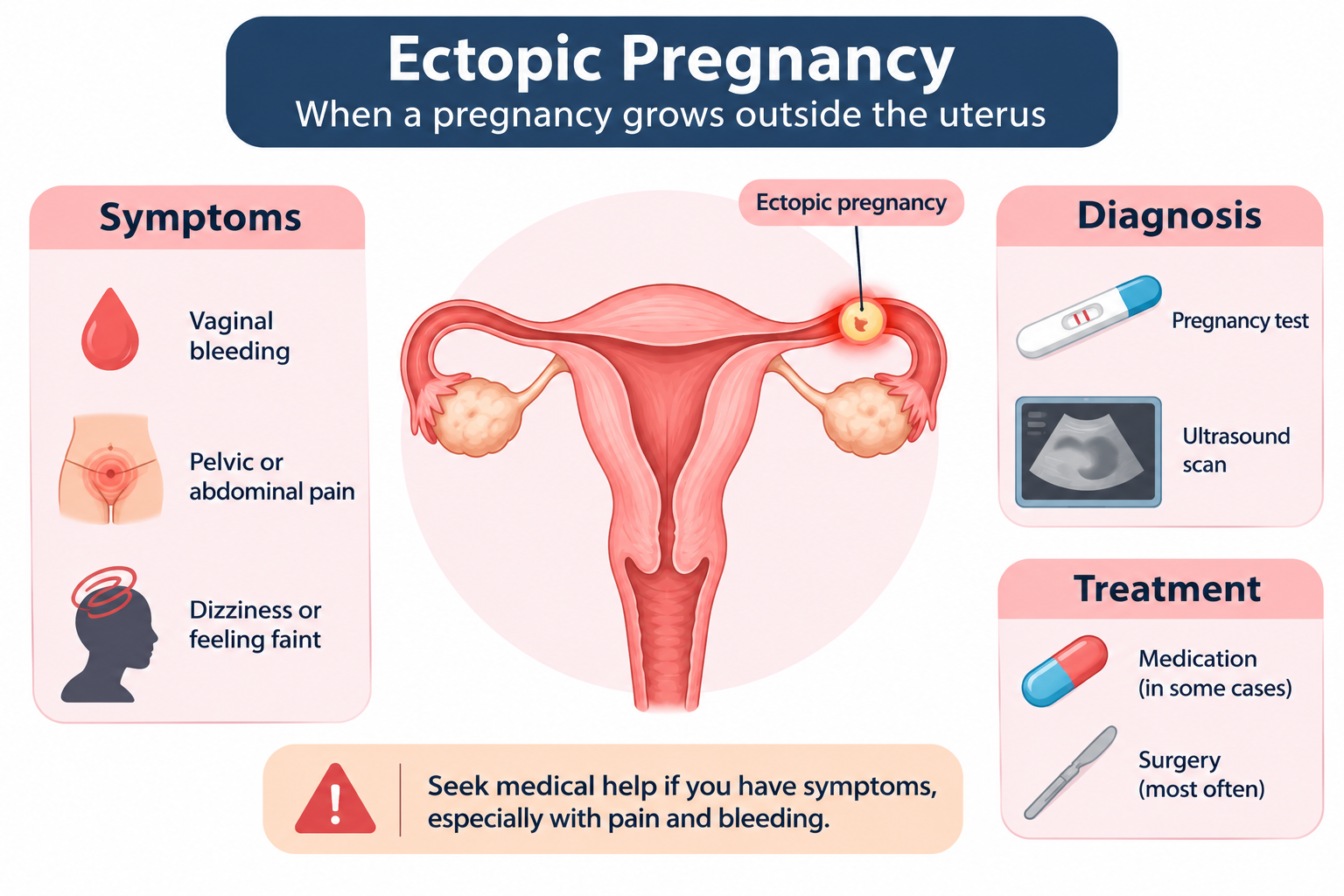

A positive pregnancy test usually brings thoughts of what comes next. But in some pregnancies, the fertilised egg implants somewhere outside the uterus instead of inside it. This is known as an ectopic pregnancy, and recognising the early signs matters because the condition can become a medical emergency if it isn’t treated.
An ectopic pregnancy most commonly develops in a fallopian tube. Because the fallopian tube isn’t designed to support a growing pregnancy, the pregnancy cannot continue normally. As it grows, it may cause the tube to rupture, leading to potentially life-threatening internal bleeding.
The difficult part is that an ectopic pregnancy doesn’t always feel unusual at first. Some women have few or no early symptoms, while others may notice vaginal bleeding, one-sided lower abdominal pain or other changes that can easily be mistaken for a period or ordinary early-pregnancy discomfort.
Knowing what to watch for can help you seek medical care sooner.
What Is an Ectopic Pregnancy?
An ectopic pregnancy is a pregnancy that develops outside the uterus (womb).
In a typical pregnancy, a fertilised egg travels through the fallopian tube and implants in the lining of the uterus, where it has the space and blood supply needed to develop. With an ectopic pregnancy, implantation happens outside the main cavity of the uterus.
Most ectopic pregnancies occur in a fallopian tube, which is why you may also hear the term tubal pregnancy. More rarely, an ectopic pregnancy can develop in other locations, including the cervix, ovary or abdominal cavity.
Unfortunately, an ectopic pregnancy cannot develop into a viable pregnancy and can pose a serious risk to the pregnant woman’s health. That’s why early diagnosis matters.
When Do Ectopic Pregnancy Symptoms Start?
Symptoms can appear quite early. According to the NHS, symptoms of an ectopic pregnancy commonly develop between the 4th and 12th weeks of pregnancy. Some women, however, initially have no noticeable symptoms at all.
This can make ectopic pregnancy difficult to recognise based on symptoms alone.
You might have a missed period or a positive pregnancy test and feel much like you would during an ordinary early pregnancy. Then something feels slightly different: unusual spotting, discomfort on one side of the abdomen or pain that doesn’t seem to go away.
These signs don’t automatically mean you have an ectopic pregnancy. Many can occur for other reasons. But when they happen during a possible or confirmed pregnancy, they shouldn’t simply be ignored.
7 Early Signs of an Ectopic Pregnancy Women Should Know
1. One-Sided Lower Abdominal or Pelvic Pain
One of the symptoms associated with ectopic pregnancy is pain low down on one side of the abdomen. The pain can develop gradually or appear suddenly. It may remain constant or come and go.
Of course, abdominal pain has many possible causes. Having pain on one side doesn’t prove that a pregnancy is ectopic. But if you’re pregnant—or could be pregnant—and develop persistent or worsening lower abdominal pain, getting medically assessed is the safer option.
2. Vaginal Bleeding or Unusual Spotting
Bleeding associated with an ectopic pregnancy may not look exactly like your normal menstrual period.
It may:
- be lighter or heavier than usual
- start and stop
- appear as spotting
- look darker than your normal period
- sometimes appear watery or brown
Because of this, some women may assume they’re simply having an unusual period and may not realise they’re pregnant. Bleeding in early pregnancy doesn’t automatically mean an ectopic pregnancy—there are several possible causes—but it deserves medical attention, particularly when accompanied by abdominal pain.
3. Shoulder Tip Pain
This is one of the more unusual warning signs. Shoulder tip pain refers to pain around the point where the shoulder ends and the arm begins. Why would a pregnancy problem cause shoulder pain?
When an ectopic pregnancy causes internal bleeding, blood inside the abdomen can irritate the diaphragm and lead to referred pain around the shoulder tip. RCOG advises seeking urgent medical attention if this occurs.
If you’re pregnant or could be pregnant and develop unexplained shoulder-tip pain alongside abdominal pain, bleeding, dizziness or weakness, don’t wait for the symptoms to become severe.
4. Pain or Pressure When Using the Toilet
Some women with an ectopic pregnancy experience discomfort when passing urine or opening their bowels.
This may include:
- pain when urinating
- pain or pressure when passing stool
- changes in bowel habits
- diarrhoea in some cases
These symptoms can easily be confused with digestive or urinary problems, which is another reason an ectopic pregnancy may not immediately be obvious.
5. Dizziness or Feeling Faint
Dizziness, weakness or fainting can become particularly concerning when they occur with severe abdominal pain or vaginal bleeding. In a ruptured ectopic pregnancy, internal bleeding can cause a person to become extremely weak, dizzy or faint.
This requires emergency medical attention.
6. Sudden, Severe Abdominal Pain
Mild abdominal discomfort and sudden severe pain are not the same thing. Sharp, intense abdominal pain can be a warning that an ectopic pregnancy has ruptured. A ruptured fallopian tube can cause significant internal bleeding and requires immediate medical treatment.
Do not wait for the pain to settle on its own.
7. Feeling Very Unwell or Weak
A combination of intense abdominal pain, dizziness, fainting, nausea, weakness or looking unusually pale can indicate significant internal bleeding. At this stage, the priority isn’t trying to work out whether the symptoms are definitely caused by an ectopic pregnancy.
It’s getting emergency medical care.
Ectopic Pregnancy Emergency Signs: When Should You Go to the Hospital?
Seek emergency medical attention immediately if you may be pregnant and experience symptoms such as:
- sudden, sharp or severe abdominal pain
- fainting or feeling as though you’re about to faint
- severe dizziness or weakness
- shoulder-tip pain, particularly with abdominal symptoms
- significant bleeding accompanied by pain or weakness
- rapidly worsening symptoms
These can be warning signs of a ruptured ectopic pregnancy and internal bleeding. A rupture is a medical emergency. You don’t need to wait until every symptom on the list appears.
What Causes an Ectopic Pregnancy?
There isn’t always an obvious explanation. An ectopic pregnancy can occur when a fertilised egg doesn’t reach the uterus as expected and instead implants elsewhere, most commonly within a fallopian tube.
Certain conditions or previous procedures can increase the likelihood of this happening, particularly when the fallopian tubes have been damaged or altered.
However, having no known risk factors doesn’t mean an ectopic pregnancy can’t happen. RCOG notes that many women diagnosed with an ectopic pregnancy have no identifiable risk factor.
Who Is More at Risk of an Ectopic Pregnancy?
An ectopic pregnancy can happen to anyone who becomes pregnant, but some circumstances are associated with a higher risk.
These include:
- a previous ectopic pregnancy
- previous damage to the fallopian tubes
- previous surgery involving the fallopian tubes
- a history of pelvic inflammatory disease (PID)
- smoking
- pregnancy following assisted conception, including IVF or ICSI
- becoming pregnant while using an intrauterine contraceptive device
It’s worth repeating: you can still have an ectopic pregnancy without having any of these risk factors. So symptoms matter even when you don’t consider yourself “high risk.”
Can You Have an Ectopic Pregnancy Without Knowing?
Yes, Some women have no symptoms during the earliest stages. The ectopic pregnancy may only be suspected during an ultrasound examination or after symptoms develop later.
That’s one reason symptoms alone aren’t enough to diagnose or rule out an ectopic pregnancy.
If you’re pregnant and something doesn’t feel right—particularly if you’re experiencing bleeding or persistent abdominal pain—speak with a healthcare professional.
Can an Ectopic Pregnancy Show Positive on a Pregnancy Test?
Yes. An ectopic pregnancy can produce the pregnancy hormone human chorionic gonadotropin (hCG), meaning a home pregnancy test may still be positive. A positive test tells you that pregnancy-related hCG has been detected. It doesn’t tell you where the pregnancy has implanted.
Determining the location of a pregnancy may require an ultrasound together with clinical assessment and, when necessary, blood tests that measure hCG levels over time.
How Is an Ectopic Pregnancy Diagnosed?
You can’t reliably diagnose an ectopic pregnancy at home based on symptoms. Medical assessment may involve several steps.
1. Medical History and Symptom Assessment
Your doctor will ask about your symptoms, pregnancy history and relevant medical history. They may want to know when the pain started, where you feel it, whether you’ve experienced bleeding and the date of your last menstrual period.
2. Pregnancy Testing
A urine or blood pregnancy test may be performed to confirm pregnancy.
3. Transvaginal Ultrasound
A transvaginal ultrasound is commonly used to identify the location of an early pregnancy.
During this scan, a small ultrasound probe is gently inserted into the vagina, allowing a closer view of the uterus, ovaries and surrounding structures. It can help determine whether a pregnancy is developing inside the uterus.
If the pregnancy is extremely early, however, it may not yet be possible to determine its location from one scan.
4. hCG Blood Tests
Blood tests may be used to measure beta-hCG, the pregnancy hormone. In some situations, the test is repeated after approximately 48 hours so doctors can assess how the hormone level is changing alongside the ultrasound findings and symptoms.
Doctors don’t generally rely on one hCG result alone to determine the location of a pregnancy.
5. Further Assessment When Necessary
If the location of the pregnancy remains uncertain, your healthcare team may recommend repeat testing, further observation or, in selected circumstances, laparoscopy.
This is why follow-up appointments are important even if your symptoms seem manageable.
What Is a Pregnancy of Unknown Location?
Sometimes a pregnancy test is positive, but an ultrasound doesn’t yet show a pregnancy either inside or outside the uterus. This may be described as a pregnancy of unknown location (PUL).
It doesn’t automatically mean the pregnancy is ectopic.
According to RCOG, possible explanations include:
- a very early pregnancy that is still too small to be seen on ultrasound
- a recent miscarriage
- an ectopic pregnancy
Further blood tests and ultrasound examinations may therefore be needed before doctors can make a definite diagnosis.
That waiting period can understandably be worrying, but careful follow-up helps doctors reach the correct diagnosis before recommending treatment.
How Is an Ectopic Pregnancy Treated?
Treatment depends on several factors, including your symptoms, the location and size of the ectopic pregnancy, hCG levels and whether there is evidence of internal bleeding.
The main approaches include:
Expectant Management
Some early ectopic pregnancies may resolve naturally without medication or surgery. In carefully selected cases, a doctor may recommend close monitoring with repeated hCG blood tests. This isn’t appropriate for everyone and requires reliable follow-up.
Medication
Some ectopic pregnancies can be treated with methotrexate, a medication that stops pregnancy tissue from continuing to grow. Regular follow-up blood tests are necessary after treatment to make sure hCG levels fall appropriately.
Surgery
Surgery may be recommended depending on the size or location of the ectopic pregnancy, symptoms, test results and the woman’s clinical condition. If the ectopic pregnancy has ruptured and caused internal bleeding, emergency surgery may be required.
Your healthcare team should explain which treatment is suitable for your individual situation.
Can an Ectopic Pregnancy Be Moved Into the Womb?
No. Once a pregnancy has implanted outside the uterus, it cannot currently be transferred or moved into the uterus. An ectopic pregnancy cannot safely continue and treatment is aimed at protecting the pregnant woman’s health.
This can be difficult news to receive, particularly for someone who has been trying to conceive. But continuing an ectopic pregnancy isn’t medically safe.
Can You Get Pregnant Again After an Ectopic Pregnancy?
For many women, yes.
Having an ectopic pregnancy doesn’t automatically mean you won’t be able to conceive or carry a pregnancy in the future. RCOG states that the chances of having a successful future pregnancy are generally good, although having had one ectopic pregnancy increases the chance of experiencing another.
Your individual fertility outlook depends on factors such as:
- the condition of your fallopian tubes
- the treatment you received
- your age
- other fertility factors
- any underlying reproductive-health conditions
If you’ve previously experienced an ectopic pregnancy and become pregnant again, speak with your healthcare provider early. An early ultrasound may be recommended to confirm that the pregnancy is developing inside the uterus.
Common Myths About Ectopic Pregnancy
Myth 1: You’ll Definitely Know If You Have an Ectopic Pregnancy
Not necessarily. Some women initially have no symptoms, while others experience symptoms that resemble an ordinary period, gastrointestinal discomfort or common early-pregnancy changes.
Myth 2: No Bleeding Means It Can’t Be Ectopic
False. Symptoms vary from person to person. Not everyone experiences every recognised symptom.
Myth 3: A Positive Pregnancy Test Means the Pregnancy Is in the Uterus
A pregnancy test detects hCG. It doesn’t identify the pregnancy’s location. Ultrasound and other medical assessments are used when the location needs to be confirmed.
Myth 4: Only Women With Fertility Problems Get Ectopic Pregnancies
No. Certain reproductive conditions and fertility treatments can increase risk, but an ectopic pregnancy can occur even when there is no known fertility problem or obvious risk factor.
Myth 5: One Ectopic Pregnancy Means You’ll Never Have a Normal Pregnancy
For many women, this isn’t true. Future successful pregnancies are possible after an ectopic pregnancy. Your doctor can discuss your individual circumstances and whether early monitoring is recommended when you conceive again.
Frequently Asked Questions About Ectopic Pregnancy
What are the first signs of an ectopic pregnancy?
Possible early signs include one-sided lower abdominal or pelvic pain, unusual vaginal bleeding or spotting, and discomfort when using the toilet. Some women have no symptoms initially.
When should I seek emergency care?
Seek emergency medical attention for severe or sudden abdominal pain, fainting, significant dizziness or weakness, shoulder-tip pain with other concerning symptoms, or rapidly worsening symptoms during a possible or confirmed pregnancy. These may indicate internal bleeding from a ruptured ectopic pregnancy.
Can an ectopic pregnancy survive?
Unfortunately, an ectopic pregnancy cannot develop normally outside the uterus and cannot be moved into the uterus. Treatment is necessary when appropriate to prevent serious complications.
Does bleeding always happen with an ectopic pregnancy?
No. Symptoms vary, and not every woman experiences vaginal bleeding. The absence of bleeding alone cannot rule out an ectopic pregnancy.
Can an ectopic pregnancy feel like a normal pregnancy?
Yes. Early symptoms such as a missed period and a positive pregnancy test can resemble those of a pregnancy developing inside the uterus. An ectopic pregnancy may not cause distinctive symptoms immediately.
Where is ectopic pregnancy pain usually located?
Pain is often felt low in the abdomen and may occur mainly on one side. It can be persistent or intermittent and may develop gradually or suddenly.
What week does an ectopic pregnancy usually cause symptoms?
Symptoms may occur between approximately 4 and 12 weeks of pregnancy, although timing varies and some women don’t initially experience symptoms.
Don’t Ignore Unusual Symptoms in Early Pregnancy
An ectopic pregnancy isn’t something you can reliably confirm from symptoms alone. And that’s really the point.
One-sided abdominal pain or spotting doesn’t automatically mean something is seriously wrong. But during early pregnancy, persistent pain, unusual bleeding or symptoms that are getting worse deserve proper medical assessment.
Early evaluation can help determine where the pregnancy is developing, identify complications, and allow your healthcare team to recommend appropriate care.
If you’ve recently had a positive pregnancy test, have concerns about symptoms in early pregnancy or need professional reproductive-health guidance, you can speak with the healthcare team at Netcare Fertility Centre for appropriate evaluation and advice.
If you’re experiencing severe abdominal pain, fainting, severe dizziness, significant weakness or other symptoms suggesting an emergency, go to the nearest emergency medical facility immediately rather than waiting for a routine fertility-clinic appointment.
Medical Disclaimer: This article is for educational purposes only and doesn’t replace diagnosis, examination or treatment by a qualified healthcare professional.