

Ovarian PRP treatment success is an increasingly searched topic among women with low ovarian reserve, poor IVF response or low AMH. But does ovarian PRP actually improve fertility outcomes?
The short answer is that ovarian platelet-rich plasma (PRP) is promising, but it’s still considered experimental. Some studies report improvements in ovarian reserve markers and the number of eggs retrieved, while evidence for improved pregnancy and live-birth rates remains limited.
So rather than asking whether PRP “works” for everyone, it’s more useful to understand what the treatment involves, what researchers have actually found and which patients are being studied.
What Is Ovarian PRP Treatment?
Ovarian PRP, sometimes called PRP ovarian rejuvenation, is a fertility treatment being investigated for women with reduced ovarian function.
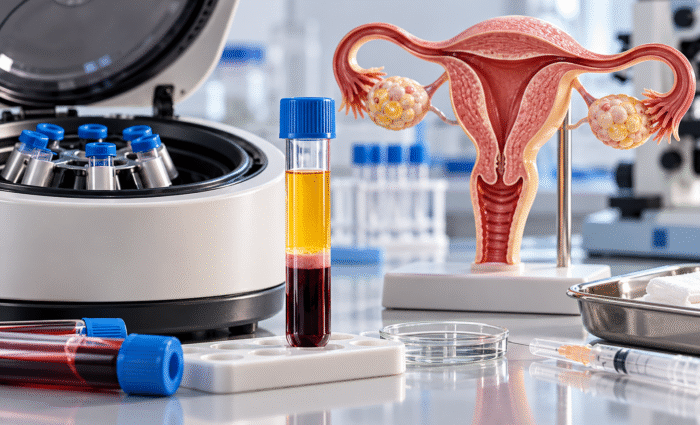
PRP stands for platelet-rich plasma. It is prepared from a sample of the patient’s own blood.
The blood is processed to concentrate platelets, which contain growth factors and other biologically active substances involved in tissue repair and cell signalling. The resulting platelet-rich plasma is then injected into the ovaries under medical guidance.
The idea is that these growth factors may influence the ovarian environment and potentially improve aspects of ovarian function.
However, there’s an important distinction: ovarian PRP isn’t currently a proven way to create a new supply of eggs or reverse ovarian ageing.
Research is still trying to establish exactly what effect, if any, PRP has on ovarian function and reproductive outcomes.
What Is the Success Rate of Ovarian PRP Treatment?
There isn’t currently one reliable ovarian PRP success rate that can be applied to every patient.
Studies use different PRP preparation methods, treatment protocols and definitions of success. Patient populations also differ considerably in age, ovarian reserve, fertility history and underlying diagnosis.
That makes percentages from individual studies difficult to compare.
A 2024 systematic review and meta-analysis involving women with diminished ovarian reserve reported a spontaneous pregnancy proportion of approximately 7% and a live-birth proportion of approximately 11% following ovarian PRP. The researchers also reported improvements in the number of retrieved oocytes and embryos. However, most of the available evidence was observational, and the authors called for larger randomized trials.
More recent evidence has reinforced the need for caution. A meta-analysis of randomized controlled trials found improvements in measures including AMH, FSH and antral follicle count, but did not find a statistically significant improvement in pregnancy rates compared with control groups.
This means PRP may affect certain ovarian measurements without necessarily translating into a higher chance of having a baby.
That difference matters.
Ovarian PRP treatment success
Research into ovarian PRP generally looks at several different outcomes rather than one definition of “success.”
1. Changes in AMH Levels
Anti-Müllerian hormone (AMH) is commonly used as one indicator of ovarian reserve.
Some studies have reported increases in AMH after ovarian PRP treatment, particularly among women with diminished ovarian reserve or poor ovarian response.
That can sound encouraging, but an increase in AMH shouldn’t automatically be interpreted as an increased chance of pregnancy.
AMH is primarily useful for estimating ovarian reserve and predicting ovarian response to stimulation. Pregnancy depends on many additional factors.
2. Changes in Antral Follicle Count
Antral follicle count, or AFC, measures small follicles visible on an ultrasound at the beginning of a menstrual cycle.
Several studies and meta-analyses have reported increased AFC after intraovarian PRP.
Again, this represents a possible biological response rather than proof that PRP will result in pregnancy or live birth.
3. Number of Eggs Retrieved
For women undergoing IVF, the number of eggs obtained following ovarian stimulation can be particularly important.
Some research has found modest increases in the number of retrieved oocytes after PRP treatment.
A 2024 meta-analysis, for example, found an average increase of less than one retrieved oocyte across the studies included in its analysis.
For someone who typically produces very few eggs during IVF, even a modest difference may be clinically interesting. But the significance varies from patient to patient.
4. Mature Eggs and Embryos
Researchers have also investigated whether PRP affects the number of mature eggs and embryos produced.
Some studies have reported improvements in mature oocyte numbers, fertilisation or embryo numbers.
But results haven’t been consistent across all studies.
5. Pregnancy Rates
This is where the evidence becomes less certain.
Although pregnancy has occurred following ovarian PRP in published studies, randomized evidence hasn’t consistently demonstrated that PRP itself significantly increases pregnancy rates compared with standard treatment or control groups.
A 2026 meta-analysis of seven randomized controlled trials involving 422 women found improvements in several ovarian reserve markers but no significant improvement in pregnancy rates.
6. Live-Birth Rates
Ultimately, live birth is one of the most meaningful outcomes when assessing fertility treatment.
Some observational studies have reported live births following ovarian PRP. However, current evidence hasn’t established that ovarian PRP reliably increases live-birth rates compared with not receiving PRP.
That is why patients should be cautious when they see clinics or online sources quoting a single impressive PRP “success rate.”
Who May Be Considered for Ovarian PRP?
Ovarian PRP has primarily been investigated in women experiencing ovarian-function challenges such as:
- Diminished ovarian reserve
- Poor ovarian response during IVF
- Premature ovarian insufficiency
- Low AMH levels
- Low antral follicle count
- Previous IVF cycles with a low number of retrieved eggs
Being in one of these categories doesn’t automatically mean PRP is appropriate.
Age, hormone results, ultrasound findings, previous treatment history and the wider cause of infertility should all be considered before deciding whether an experimental treatment is reasonable.
Ovarian PRP and Diminished Ovarian Reserve
Diminished ovarian reserve (DOR) means the number of eggs remaining in the ovaries is lower than expected for a woman’s reproductive stage.
It doesn’t necessarily mean pregnancy is impossible.
Doctors commonly assess ovarian reserve using a combination of:
- AMH testing
- Antral follicle count
- FSH and other hormone tests
- Age
- Previous response to ovarian stimulation
Ovarian PRP has attracted particular interest for DOR because several studies have reported changes in AMH, AFC and egg retrieval after treatment.
However, these changes don’t necessarily mean that ovarian ageing has been reversed.
That’s one reason the term “ovarian rejuvenation” should be interpreted carefully.
Ovarian PRP and Poor IVF Response
Some women undergoing IVF produce fewer follicles or eggs than expected despite ovarian stimulation.
These patients are often described as poor ovarian responders.
Researchers have investigated PRP as a possible pretreatment before another IVF cycle.
A 2025 systematic review found mixed results. Some studies reported improved IVF pregnancy outcomes, while others found no significant benefit or produced inconclusive findings.
So PRP shouldn’t be presented as a guaranteed solution after a failed or poor-response IVF cycle.
Instead, the entire previous cycle needs to be reviewed.
Questions may include:
- How many follicles developed?
- How many eggs were retrieved?
- How many eggs were mature?
- How many fertilised?
- Did embryos develop?
- Was embryo transfer performed?
- Were there other female or male fertility factors?
Those details may be more useful for planning the next treatment than focusing on AMH alone.
How Is Ovarian PRP Treatment Performed?
Protocols vary between fertility centres, but the general process may involve the following steps.
Step 1: Blood Collection
A small amount of the patient’s blood is collected.
Step 2: PRP Preparation
The blood is processed, typically using centrifugation, to separate and concentrate the platelet-rich component.
Step 3: Ovarian Injection
The prepared PRP is introduced into the ovaries using an image-guided procedure performed by a trained fertility specialist.
Step 4: Follow-Up
The fertility team may monitor ovarian function over the following weeks or months.
Depending on the treatment plan, follow-up may include hormone testing, ultrasound monitoring or preparation for IVF.
Because ovarian PRP protocols haven’t yet been standardized internationally, preparation, dosage, timing and follow-up can differ between centres.
How Long After Ovarian PRP Can You See Results?
There isn’t a universally established timeline.
Some clinical studies reassess ovarian reserve markers or begin fertility treatment within the following weeks or months.
The appropriate timing depends on the PRP protocol, the patient’s fertility history and the treatment being planned afterwards.
This is another area where more standardized research is needed.
What Factors May Affect Ovarian PRP Treatment Outcomes?
Two women receiving the same treatment may have very different outcomes.
Important factors can include:
Age
Age remains one of the strongest factors influencing female fertility, particularly because egg quantity and quality decline over time.
Baseline Ovarian Reserve
AMH, AFC and previous ovarian response help fertility specialists understand how the ovaries may respond to stimulation.
Previous IVF Response
The number of eggs retrieved, mature eggs obtained and embryos created during previous IVF cycles provides valuable information.
Underlying Diagnosis
Diminished ovarian reserve, premature ovarian insufficiency and poor ovarian response aren’t identical conditions.
PRP may therefore not have the same potential effect in every group.
Egg Quality
Increasing ovarian reserve markers doesn’t necessarily improve the genetic quality of an egg.
This becomes particularly relevant as maternal age increases.
Other Fertility Factors
Pregnancy also depends on sperm quality, fertilisation, embryo development, uterine health, fallopian-tube factors and other medical considerations.
That’s why ovarian PRP shouldn’t be evaluated in isolation.
Common Myths About Ovarian PRP
Myth 1: PRP Creates New Eggs
This hasn’t been established.
Women are generally understood to have a finite ovarian follicle pool, and current evidence doesn’t prove that PRP creates an entirely new supply of eggs.
Myth 2: Higher AMH Means PRP Worked
Not necessarily.
AMH is useful, but fertility treatment success can’t be measured by one laboratory value.
A more meaningful assessment may include ovarian response, mature egg numbers, embryo development, pregnancy and ultimately live birth.
Myth 3: PRP Reverses Menopause
There isn’t enough evidence to claim that ovarian PRP reverses natural menopause.
Research involving premature ovarian insufficiency has reported changes in ovarian markers or menstrual activity in some patients, but these findings shouldn’t be interpreted as established reversal of menopause.
Myth 4: PRP Guarantees Better IVF Results
No fertility treatment can guarantee pregnancy.
Ovarian PRP remains an investigational treatment, and some women may experience no measurable improvement.
Is Ovarian PRP Safe?
Because PRP is produced from the patient’s own blood, the risk of allergic reaction to the injected material itself may be relatively low.
However, ovarian PRP still involves an invasive procedure.
Potential procedural risks can include:
- Bleeding
- Infection
- Pain or discomfort
- Injury to nearby structures
- Risks associated with sedation or anaesthesia, where applicable
Current reviews haven’t identified major procedure-related safety signals in the available studies, but long-term and large-scale safety evidence remains limited.
Patients should discuss both potential benefits and uncertainties before proceeding.
Questions to Ask Before Considering Ovarian PRP
If you’re considering PRP, don’t focus only on the advertised success rate.
Ask your fertility specialist:
- Why do you think ovarian PRP may be appropriate for my specific diagnosis?
- What outcome are we trying to improve—AMH, egg numbers, IVF response, pregnancy or something else?
- What evidence supports PRP for women in my age and ovarian-reserve category?
- What are the possible risks?
- How will we determine whether the treatment has helped?
- When would IVF or another fertility treatment begin afterwards?
- What alternatives should I consider?
- What happens if my ovarian response doesn’t improve?
A good fertility plan should be based on your individual circumstances rather than a treatment trend.
What is the success rate of ovarian PRP?
There is currently no universally accepted ovarian PRP success rate. Published studies report different pregnancy and live-birth outcomes, and results vary depending on patient characteristics and study design. More high-quality randomized trials are needed.
Can ovarian PRP increase AMH?
Some studies have reported increased AMH after ovarian PRP, particularly in women with diminished ovarian reserve or poor ovarian response. However, an increase in AMH doesn’t necessarily mean pregnancy chances have increased
Can you get pregnant naturally after ovarian PRP?
Natural pregnancies have been reported after ovarian PRP treatment, but current evidence can’t establish how much of that outcome is directly caused by PRP. Individual fertility factors remain important.
Does ovarian PRP improve egg quality?
There is some preliminary research into oocyte maturation, fertilisation and embryo outcomes after PRP, but there isn’t enough high-quality evidence to conclude that ovarian PRP reliably improves egg quality.
Can ovarian PRP help with low AMH?
Women with low AMH or diminished ovarian reserve are among the main groups studied for ovarian PRP. Some research has reported improvements in AMH and other ovarian reserve markers, but treatment response isn’t guaranteed.
Can ovarian PRP improve IVF success?
Possibly for selected patients, but this hasn’t been proven conclusively. Some studies have found improvements in ovarian response or egg numbers, while randomized evidence hasn’t consistently demonstrated higher pregnancy rates
Is ovarian PRP a proven fertility treatment?
No. Ovarian PRP is still considered an experimental or investigational approach because evidence about its effect on pregnancy and live birth remains insufficient and treatment protocols aren’t standardized.
The Bottom Line: Does Ovarian PRP Work?
Ovarian PRP is an interesting area of fertility research, particularly for women with diminished ovarian reserve or a history of poor ovarian response.
There are encouraging findings. Studies have reported changes in AMH, FSH, antral follicle count, egg retrieval and other fertility parameters after treatment.
But there’s another side to the evidence.
Improvements in laboratory markers don’t automatically translate into improved pregnancy or live-birth rates. Recent randomized evidence hasn’t consistently demonstrated that ovarian PRP significantly increases pregnancy rates.
For that reason, PRP is better viewed as an emerging, experimental fertility treatment rather than a proven method of ovarian rejuvenation.
If you’ve been diagnosed with diminished ovarian reserve, have a low AMH result or have experienced a poor response during IVF, the most useful next step is a comprehensive fertility assessment. A fertility specialist can review your age, ovarian reserve, previous treatment response and overall reproductive health before discussing whether PRP or another treatment approach may be appropriate.
At Netcare IVF | Fertility, fertility evaluation and treatment planning are tailored to the individual rather than based on a single test result. If you’re considering ovarian PRP or want to understand your options after a poor ovarian response, you can discuss your fertility history and available treatment options with the clinical team.