
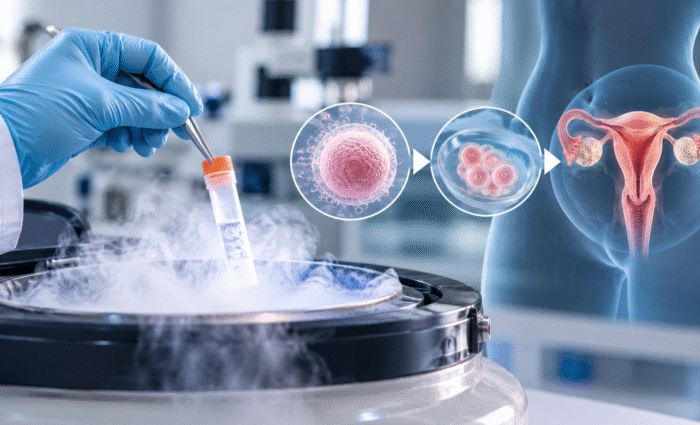

The best age to freeze your eggs in Nigeria depends on your individual circumstances, but women who are considering fertility preservation are generally encouraged to explore their options earlier rather than later. Egg quantity and quality decline with age, particularly from the mid-30s onward.
If you’re thinking about delaying pregnancy, understanding how your age affects egg freezing can help you make a more informed decision about your reproductive future.
For many women considering egg freezing, before age 35 is generally a favourable time to explore the option because egg quantity and quality decline with age. However, there isn’t one perfect age that applies to everyone. Your ovarian reserve, medical history, reproductive goals and reason for delaying pregnancy all matter.
The key point is simple: the age at which your eggs are frozen matters more than the age at which you eventually return to use them. That’s why speaking with a fertility specialist earlier can give you more information and more options.
What Is Egg Freezing?
Egg freezing, medically known as oocyte cryopreservation, is a fertility preservation procedure that allows a woman’s eggs to be collected from the ovaries and frozen for possible future use.
The process typically involves:
- An initial fertility assessment
- Ovarian stimulation using prescribed fertility medications
- Monitoring follicle development
- Egg retrieval
- Freezing mature eggs, commonly using vitrification
- Storing the frozen eggs until they may be needed
When you’re ready to try for pregnancy in the future, the eggs can be thawed and fertilised with sperm through assisted reproductive treatment.
Egg freezing does not guarantee a future pregnancy, but it can preserve reproductive options for women who aren’t ready to have children now or whose future fertility may be affected by medical treatment.
Best Age to Freeze Your Eggs in Nigeria
There is no universal age that guarantees the best outcome, but younger eggs generally have greater reproductive potential.
Female fertility is highest during the late teens and 20s. It begins to decline around age 30, with the decline becoming faster during the mid-30s.
For this reason, women who already know they may want to delay pregnancy may benefit from discussing egg freezing with a fertility specialist before age 35.
This doesn’t mean you suddenly become infertile at 35. You don’t.
Rather, fertility changes gradually, and age 35 is useful as a general clinical reference point because the decline in egg quantity and quality becomes more significant as women move through their mid-to-late 30s.
Why Does Age Matter When Freezing Your Eggs?
A woman is born with a finite number of eggs. Unlike many other cells in the body, new eggs aren’t continuously produced throughout adulthood.
As you get older, two important things happen:
- The number of available eggs decreases.
- The proportion of eggs with chromosomal abnormalities increases.
This is why your age when the eggs are collected and frozen is so important.
Freezing eggs at a younger age preserves the eggs at approximately the biological age they were when collected. So, for example, eggs frozen at 31 don’t biologically become 39-year-old eggs simply because you return to use them eight years later.
However, your age when you become pregnant can still influence pregnancy-related health risks. Egg freezing preserves eggs; it does not stop the rest of the body from ageing.
Egg Freezing in Your 20s
Biologically, your 20s are generally a favourable period for egg quality.
Does that mean every woman in her 20s should freeze her eggs?
No.
If you’re 24, for example, and expect to start a family within the next few years, egg freezing may not necessarily be worthwhile.
But it may deserve consideration if you have a medical condition or treatment that could affect fertility, a family history that raises fertility concerns, or personal circumstances that mean pregnancy is likely to be delayed for a considerable period.
A fertility assessment can help you understand whether preservation makes sense for your particular situation.
Egg Freezing Between Ages 30 and 34
For women planning to delay motherhood, the early 30s can be an important window for discussing fertility preservation.
At this stage, egg quality is generally better than it will be later in the reproductive years, while many women also have a clearer picture of their family-building plans.
Perhaps you’re focused on your career.
Maybe you haven’t met the right partner.
Maybe marriage or parenthood simply isn’t part of your immediate plan.
Or perhaps you know you want children eventually but aren’t ready now.
These are all reasons someone might want to learn about egg freezing.
The decision shouldn’t come from panic. It should come from understanding your fertility and the available options.
Can You Freeze Your Eggs at 35?
Yes.
Being 35 does not automatically make you unsuitable for egg freezing.
However, fertility generally declines more quickly from the mid-30s onward, which can affect both the number and reproductive potential of the eggs collected.
This is why someone considering egg freezing at 35 shouldn’t assume she has already “missed her chance.”
Instead, this is a good reason to arrange a fertility assessment sooner rather than continuing to postpone the conversation.
Can You Freeze Your Eggs After 35?
Egg freezing may still be possible after age 35, but expectations need to be realistic.
The chances associated with frozen eggs generally decline as age at freezing increases.
Depending on your ovarian reserve and individual circumstances, your fertility specialist may discuss whether more than one stimulation and retrieval cycle could be considered to obtain an appropriate number of mature eggs.
Age alone doesn’t tell the whole story, though.
Two women who are both 37 can have different ovarian responses, reproductive histories and fertility circumstances.
That’s why individual assessment matters.
Is 40 Too Late to Freeze Your Eggs?
This requires a careful discussion with a fertility specialist.
Egg freezing can sometimes be performed around age 40, but the likelihood of achieving a future live birth using eggs frozen at older reproductive ages is generally lower than when eggs are frozen younger.
If you’re approaching or over 40, don’t automatically assume that fertility preservation is impossible. But you should receive realistic counselling about your individual situation, likely response to treatment and available reproductive options before making a decision.
Why Earlier Egg Freezing Can Be Beneficial
Freezing eggs earlier may offer several potential advantages.
Better Egg Quality
Age is strongly associated with egg quality. Younger eggs are generally less likely to have age-related chromosomal abnormalities.
Potentially Better Future Reproductive Chances
Younger age at egg freezing is associated with better reproductive outcomes compared with freezing at older ages.
Potentially More Eggs From a Treatment Cycle
Ovarian reserve generally declines with age, although there is considerable variation between individuals.
More Reproductive Options
For some women, fertility preservation reduces the pressure to make major relationship, career or family decisions solely because of concerns about reproductive ageing.
Still, egg freezing should be viewed as an option rather than an insurance policy. No fertility clinic can guarantee that frozen eggs will eventually result in a baby.
Who Should Consider Egg Freezing in Nigeria?
Women consider egg freezing for many different reasons.
You may want to discuss fertility preservation if:
- You’re planning to delay having children.
- You’re not currently ready for motherhood but want biological children in the future.
- You haven’t found the right partner yet.
- You’re pursuing education, career or other major personal goals.
- You have been diagnosed with a condition that could affect fertility.
- You’re preparing for chemotherapy, radiotherapy or another treatment that could affect ovarian function.
- You’re undergoing surgery that may affect the ovaries.
- You have concerns about declining ovarian reserve.
- You have a family history that raises concerns about reproductive ageing.
Medical fertility preservation can sometimes be time-sensitive. If you’re about to undergo treatment that may damage fertility, speak with both your treating doctor and a fertility specialist as early as possible.
How Do Doctors Assess Whether Egg Freezing Is Right for You?
Age is important, but a fertility specialist won’t usually look at your birthday and stop there.
An assessment may consider your medical and reproductive history alongside tests used to evaluate ovarian function and expected response to stimulation.
Depending on your circumstances, your fertility specialist may recommend assessments such as:
AMH Testing
Anti-Müllerian hormone (AMH) can help clinicians estimate ovarian reserve and predict how the ovaries may respond to stimulation.
It should not be interpreted as a simple “fertility score,” however. AMH alone cannot tell you whether you will or won’t become pregnant naturally.
Antral Follicle Count
An ultrasound may be used to assess the number of visible follicles within the ovaries.
Medical and Reproductive History
Your menstrual cycle, previous pregnancies, surgeries, medications, medical conditions and family history can provide important context.
These findings help your fertility specialist develop a more individualised treatment plan.
What Happens During the Egg-Freezing Process?
If you decide to freeze your eggs, the process generally follows several stages.
Step 1: Fertility Consultation
You’ll meet with a fertility specialist to discuss your medical history, future reproductive goals and whether egg freezing is appropriate for you.
Step 2: Fertility Assessment
Blood tests and ultrasound assessment may be recommended to evaluate ovarian reserve and help plan treatment.
Step 3: Ovarian Stimulation
You’ll take prescribed fertility medications to encourage multiple follicles to develop during one treatment cycle.
Step 4: Monitoring
Your response is monitored using ultrasound scans and, where appropriate, hormone tests.
Step 5: Egg Retrieval
Once the follicles are ready, the eggs are retrieved through a medical procedure, usually under sedation or anaesthesia.
Step 6: Vitrification and Storage
Suitable mature eggs are rapidly frozen through vitrification and stored for potential future use.
When you decide to use them, the eggs are thawed and surviving mature eggs can be fertilised as part of fertility treatment.
A Real-World Example
Imagine two women who both hope to have their first child at 39.
One begins exploring egg freezing at 31. The other starts considering it at 38.
They may be the same age when they’re eventually ready for motherhood, but the biological age of the eggs they froze would be very different.
That’s why waiting until you’re ready to become pregnant isn’t always the best time to start thinking about fertility.
You don’t necessarily need to freeze your eggs today.
But if you know you may delay pregnancy for several years, understanding your options earlier can be useful.
Common Myths About Egg Freezing
Myth 1: “If I Freeze My Eggs, I’m Guaranteed to Have a Baby Later.”
No. Egg freezing can preserve reproductive potential, but it cannot guarantee pregnancy or live birth.
Success depends on several factors, including age when the eggs were frozen, number of mature eggs available, survival after thawing, fertilisation and embryo development.
Myth 2: “I Should Wait Until My Late 30s Before Thinking About It.”
Waiting may reduce the reproductive potential of the eggs available for freezing.
If you already expect to delay pregnancy significantly, an earlier conversation with a fertility specialist can help you make an informed decision.
Myth 3: “35 Means My Fertility Suddenly Disappears.”
No.
Fertility decline is gradual rather than something that happens overnight on your 35th birthday. The decline generally becomes more pronounced during the mid-to-late 30s.
Myth 4: “AMH Tells Me Whether I Can Get Pregnant.”
Not exactly.
AMH is useful in evaluating ovarian reserve and predicting ovarian response during fertility treatment, but it isn’t a stand-alone test of whether you can conceive naturally.
Myth 5: “Frozen Eggs Always Work When You’re Ready.”
Unfortunately, no fertility-preservation method can make that promise.
Some eggs may not survive warming, fertilise normally or develop into embryos capable of resulting in a healthy live birth.
Egg Freezing in Nigeria: When Should You Speak to a Fertility Specialist?
If you’re considering egg freezing in Nigeria, you don’t need to wait until you’ve made a final decision before booking a consultation.
In fact, consultation should come before the decision.
You may particularly want to seek professional advice if you’re in your early-to-mid 30s and expect to delay pregnancy for several years, or if you have a medical condition or upcoming treatment that could affect fertility.
The goal of the consultation isn’t to pressure you into freezing your eggs.
It’s to understand your reproductive health well enough to make an informed choice.
What is the best age to freeze your eggs?
There isn’t one universally recommended age for everyone. However, egg quality and quantity generally decline with age, and freezing eggs at a younger age is associated with better reproductive outcomes. Women considering delaying pregnancy may benefit from discussing egg freezing before age 35
Is 30 a good age to freeze eggs?
For someone who expects to delay pregnancy for several years, age 30 can be a reasonable time to discuss fertility preservation with a specialist. Whether you should actually freeze your eggs depends on your circumstances, reproductive goals and clinical assess
Is 35 too late to freeze my eggs?
No. Women can freeze eggs at 35 and beyond. However, egg quantity and quality generally decline with age, so it is worth seeking an individual assessment rather than delaying simply because you think you’ve already missed the opportunity
Can I freeze my eggs at 40 in Nigeria?
It may be possible, depending on your individual circumstances and clinic assessment. However, success rates using eggs frozen at older ages are generally lower. A fertility specialist should discuss realistic expectations and other available options with you
How long does egg freezing take?
The active treatment process commonly takes around two to three weeks, although the exact timeline varies depending on your treatment protocol and response to ovarian stimulation.
Does freezing eggs guarantee pregnancy?
No. Egg freezing preserves reproductive options but does not guarantee a future pregnancy or live birth.
Where can I freeze my eggs in Nigeria?
Egg freezing is available through fertility centres offering assisted reproductive technology and fertility-preservation services. If you’re considering egg freezing in Lagos, you can schedule a consultation with Netcare Fertility Centre to discuss your age, ovarian reserve, reproductive plans and available fertility-preservation options.
Final Thoughts: Don’t Wait for a “Perfect” Age to Ask Questions
So, what’s the best age to freeze your eggs?
There isn’t one magic birthday.
But biology does matter. Egg quantity and quality generally decline as women get older, and outcomes tend to be better when eggs are frozen at younger reproductive ages.
If you know you want children someday but aren’t ready now, getting information early gives you something valuable: choice.
A fertility assessment doesn’t commit you to treatment. It simply helps you understand where you stand and what options may be available.
If you’re considering egg freezing in Nigeria, book a fertility consultation with Netcare Fertility Centre to discuss your reproductive goals and receive personalised guidance based on your age, health and fertility assessment.
This article is for educational purposes and should not replace personalised medical advice from a qualified fertility specialist.