
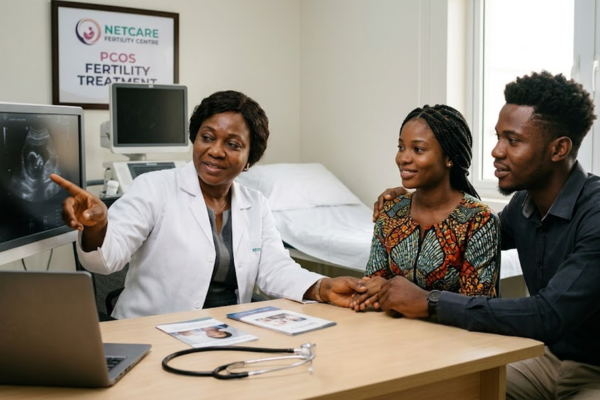

If you are seeking effective PCOS fertility treatment after spending months (or maybe years) staring at blank, single-lined pregnancy tests, dealing with stubborn acne that belongs in a teen drama, or wondering why your period seems to operate on its own highly chaotic schedule, you are probably feeling exhausted.
And if you recently sat in a clinic, heard the words “Polycystic Ovary Syndrome” (PCOS), and left with a handful of pamphlets and a sinking feeling in your stomach, we want you to take a deep, centering breath.
First, let’s get the most important truth out of the way: A PCOS diagnosis is not a closed door on your dream of holding your baby.
Yes, it is a hurdle. Yes, it can make the path to pregnancy feel like a maze. But PCOS is also one of the most thoroughly researched, deeply understood, and highly treatable causes of female infertility. Globally, about 1 in 10 women of reproductive age walks this exact path. In Nigeria, the numbers are equally significant, meaning you are part of a massive community of women who have faced this exact diagnosis and gone on to build beautiful, healthy families.
At Netcare Fertility Centre in Akure, Ondo State, we do not believe in scaring you with clinical jargon or handing you a generic, copy-and-paste treatment plan. Your body is not a textbook. Your hormonal balance is completely unique to you.
This guide is designed to strip away the clinical coldness of reproductive medicine and give you a warm, honest, and scientifically robust look at how we treat PCOS, wake up your ovaries, and walk beside you on the journey to parenthood.
What Actually Happens Inside a PCOS Ovary? (Demystifying the “Cysts”)
To beat an obstacle, you first have to understand exactly how it works. Let’s pull back the curtain on your ovaries.
In a textbook menstrual cycle, your ovaries are like a beautifully synchronized stage production. Each month, your brain releases signals (like Follicle-Stimulating Hormone, or FSH) telling a group of tiny, fluid-filled sacs in your ovaries—called follicles—to start growing. Each follicle contains an immature egg.
As the weeks progress, one “star” follicle outgrows the rest, matures fully, and bursts open to release a healthy egg. This is ovulation, and it is the single most critical event required for natural conception.
If you have PCOS, however, the backstage communication breaks down due to two primary culprits: insulin resistance and elevated androgens (male hormones like testosterone, which all women naturally have, but are higher in those with PCOS).
Here is how that plays out in your body:
1. The “Traffic Jam” (Anovulation)
Instead of one follicle growing to maturity and releasing an egg, the elevated androgens halt the development process midway. Dozens of tiny follicles start to grow but get “stuck” at a very small stage. Because they never mature, they cannot release an egg.
2. The Misunderstood “Cysts”
When doctors look at a PCOS ovary on an ultrasound, they see dozens of these tiny, stalled follicles resting just under the surface of the ovary. They look exactly like a “string of pearls.”
Historically, medical science labeled these “cysts,” which is incredibly misleading. These are not dangerous tumors or fluid sacs that need to be surgically cut out; they are simply immature follicles that got stuck waiting for the signal to grow.
3. The Absent Calendar
Because your ovaries are locked in this perpetual holding pattern, waiting for a follicle to mature, your body doesn’t get the hormonal triggers to shed its lining. This is why your periods might only show up every few months, completely disappear, or occasionally arrive with sudden, heavy intensity.
The Metabolic Connection: Why Insulin Holds the Key
It surprises many women to learn that PCOS isn’t just a “gynecological” issue—it is deeply rooted in your metabolic health. At the heart of most PCOS cases lies insulin resistance.
Insulin is the hormone responsible for unlocking your cells to let glucose (sugar) in for energy. When you have insulin resistance, your cells ignore insulin’s knocks. Your pancreas reacts by pumping out more and more insulin to get the job done.
While your muscle and fat cells might be ignoring this insulin, your ovaries are highly sensitive to it. High levels of insulin circulating in your bloodstream act like an accelerator pedal on your ovaries, screaming at them to produce more testosterone.
This excess testosterone is the direct brake pad on your ovulation. It is also the culprit behind unwanted facial hair, stubborn weight gain around the midsection, and hormonal acne along the jawline.
By understanding this connection, we realize that treating PCOS fertility issues isn’t just about giving you ovulation drugs; it’s about fixing your body’s metabolic communication.
Our Step-by-Step PCOS Fertility Treatment Pathway in Akure
At Netcare Fertility Centre, we don’t believe in over-medicalizing your body right out of the gate. We take a measured, progressive approach. We start with the gentlest, most natural interventions, and only scale up to high-tech assistance if and when your body needs the extra support.
- Comprehensive Diagnostic Mapping: Step 1: Diagnostics.
Before we write a single prescription, we need a complete map of your endocrine system. We perform high-resolution pelvic ultrasounds to visualize your ovaries and endometrial lining. This is paired with a targeted blood panel to measure AMH (Anti-Müllerian Hormone), LH, FSH, thyroid function, prolactin, free testosterone, and fasting insulin levels. This ensures we are treating PCOS, and not mimicking conditions like thyroid dysfunction.
2. The Metabolic & Nutritional Reset: Step 2: Lifestyle.
We work with you to design a realistic, sustainable lifestyle approach tailored to Nigerian cuisine. We focus on low-glycemic local foods (swapping refined white flours for complex carbs like local brown rice, unripe plantains, and fiber-rich vegetables) to manage insulin spikes. When necessary, we introduce insulin-sensitizing agents like Metformin or high-quality Inositol supplements to naturally lower androgen levels and restore spontaneous ovulation.
3. Targeted Ovulation Induction (OI): Step 3: Ovulation Induction.
If your cycles remain irregular, we introduce oral medications to gently kickstart follicle growth. Our primary choice is Letrozole, which clinical research has proven to be highly superior to older drugs like Clomid for women with PCOS. We do not just hand you pills and send you home; we use highly precise ultrasound follicle tracking to monitor your response, measure your lining, and pinpoint the exact day of ovulation to maximize your chances of natural conception.
4. Assisted Reproductive Technologies (IUI & IVF): Step 4: Advanced Help.
If your fallopian tubes are blocked, if there is a co-existing male fertility factor, or if repeated ovulation induction cycles do not lead to pregnancy, we transition to advanced care. This includes Intrauterine Insemination (IUI) or In Vitro Fertilization (IVF). In our state-of-the-art laboratory, we can carefully harvest your mature eggs, fertilize them in a controlled environment, and select the healthiest embryo to transfer back to your uterus.
Why Netcare Fertility Centre is Akure’s Trusted Home for Fertility Care
The emotional weight of trying to conceive is heavy enough without the added burden of constant travel. Many couples in Ondo State believe they have to endure the grueling, expensive logistics of traveling to Lagos or Abuja to access premium fertility treatments.
We established Netcare Fertility Centre in Akure specifically to change that narrative. We believe that world-class, scientifically advanced reproductive medicine should be accessible right where you live, work, and rest.
1. Advanced, Localized Clinical Expertise
Our laboratory and clinical facilities in Akure match the diagnostic and treatment standards found in major metropolitan centers. From advanced embryology equipment to state-of-the-art ultrasound machines, you do not sacrifice quality by staying close to home.
2. A Focus on Safety and Cycle Monitoring
Ovulation induction medications are powerful. Without careful monitoring, they can lead to risks like Ovarian Hyperstimulation Syndrome (OHSS)—where the ovaries overreact and produce too many follicles—or unplanned high-order multiple pregnancies (triplets or more).
At Netcare, we place absolute priority on meticulous cycle monitoring. We track your follicles step-by-step, adjusting your dosages in real-time to ensure your safety and optimize your success rates.
3. A Holistic, Empathetic Team
We know that you are more than your ovaries. Hormonal struggles can impact your mental health, your marriage, and your self-esteem.
Our team of fertility specialists, compassionate nurses, and counselors take the time to sit down with you, answer your late-night questions, and demystify every step of the process. You are never just a folder number to us.
4. Direct, Transparent Pricing
Fertility treatments are an investment. We believe that financial stress should never be a surprise barrier to your care. At Netcare, we pride ourselves on absolute transparency. Before you begin any treatment protocol, you will receive a detailed, clear breakdown of costs—no hidden fees, no unexpected lab charges.
Demystifying PCOS: Your Questions, Answered Honestly
Why is Letrozole preferred over Clomid (Clomiphene Citrate) now?
For decades, Clomid was the gold standard for ovulation induction. However, modern clinical trials have shown that Letrozole is far more effective for women with PCOS.
Clomid can sometimes thin out your uterine lining and dry up cervical mucus (both of which make it harder for an embryo to implant). Letrozole doesn’t have these side effects, leads to higher live-birth rates, and has a lower risk of causing multiple pregnancies. That is why Letrozole is our primary, first-line choice at Netcare.
How long does PCOS fertility treatment typically take?
Because we progress step-by-step, the timeline varies. Many couples achieve pregnancy within three to six cycles of well-monitored ovulation induction.
If we need to transition to IVF, the process typically takes about four to six weeks from the start of ovarian stimulation to embryo transfer. We will map out a realistic, clear timeline during your initial consultation so you know exactly what to expect.
Can I actually get pregnant naturally if I have PCOS?
Yes, absolutely. Many women with milder variants of PCOS are able to conceive without heavy medical intervention.
Often, losing just 5% to 10% of body weight (if you are carrying extra weight), shifting to a low-glycemic diet, managing chronic stress, and using ovulation prediction kits can naturally restore your cycles. However, if you’ve been trying consistently for over a year (or six months if you are over 35), it is time to let a specialist help streamline the process.
I have “lean PCOS” (I am not overweight). Do I still need to worry about insulin?
Yes, this is a very common misconception! While classic PCOS is often associated with weight struggles, “Lean PCOS” affects many women of average or below-average weight.
Even if your body weight is normal, you can still have cellular insulin resistance that triggers excess androgen production in your ovaries. The treatment principles remain similar: we focus on stabilizing blood sugar, optimizing egg quality, and gently inducing ovulation.
Taking Back Control of Your Fertility Journey
When you have PCOS, it is easy to feel like your body is working against you. It can feel deeply frustrating to watch your cycle fluctuate unpredictably while trying to plan for a family.
But remember: your body is not broken. It simply has a metabolic and hormonal communication glitch—one that modern reproductive science knows exactly how to tune.
You do not have to navigate this confusing landscape alone, and you do not have to travel far to find answers. The team at Netcare Fertility Centre is here to provide the clinical expertise, advanced technology, and gentle, personalized care you deserve, right here in Akure.
Let’s turn your ovulation traffic jam into a clear path forward.